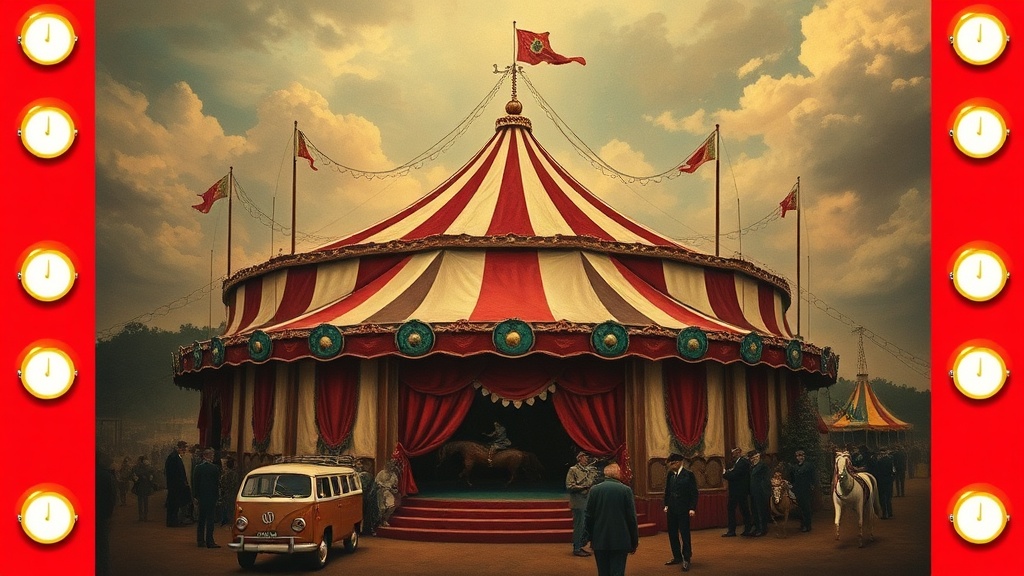
How to Read Vintage Circus Posters as Windows Into Changing Entertainment Values

What Can Old Circus Posters Tell Us About What Audiences Used to Crave?
In 1910, the Ringling Bros. Circus spent more on lithography than they paid their entire performing troupe. That single fact upends how we think about entertainment history—we imagine audiences flocking to witness death-defying acts, yet the circus owners knew the poster did the heavy lifting of persuasion before anyone bought a ticket. These vibrant, exaggerated sheets weren't mere advertisements. They were barometers of cultural appetite, reflecting what made crowds gasp, what made them feel safe enough to be thrilled, and what they believed about distant lands and peoples.
Surviving circus posters—those massive, weathered sheets hawking "The Great Orient," "Human Oddities," or "Ferocious Beasts from Darkest Africa"—offer historians something rare: entertainment ephemera designed for mass consumption that actually survived. Unlike ticket stubs or cotton candy wrappers, posters were collectible, displayed in shop windows, and often pasted over repeatedly until they formed archaeological layers of public desire. Reading them properly means understanding their visual grammar, their textual strategies, and their uncomfortable honesty about what past audiences paid to see.
Why Did Circus Posters Rely So Heavily on Specific Color Schemes?
The color palette of a circus poster wasn't decorative—it was psychological warfare against competing entertainments. Early lithographers like Strobridge & Co. and The Courier Company developed signature approaches that trained the public eye. Bright yellows dominated because the pigment (chrome yellow) was both inexpensive and visible from remarkable distances. Reds signaled danger and excitement, while deep blues lent an air of exoticism that made Middle American audiences feel they were purchasing temporary passports to elsewhere.
By the 1890s, stone lithography allowed for six to eight colors per sheet—a technological leap that poster designers exploited without restraint. The result was what critics then called "chromo-civilization": a visual shouting match where restraint meant commercial death. When you examine a poster from this era, look at how color directs attention. The human eye travels from the brightest point (usually the performer's face or the animal's open maw) to secondary information (dates, ticket prices) through deliberately plotted chromatic pathways. These weren't accidents—they were the user interface design of their day, refined through constant A/B testing across thousands of Midwestern towns.
The material quality matters too. Surviving posters printed on thicker stock were meant for indoor display (theaters, hotels), while thinner, cheaper papers were designed for outdoor posting—meaning the circus expected rain, wind, and competing advertisers to destroy them within days. A well-preserved outdoor poster suggests the town was smaller than advertised, or the weather uncooperative, or public interest so low that nobody bothered tearing them down. The paper itself becomes evidence.
How Do You Decode the Exaggerated Claims and "Freak" Language?
Modern readers flinch at the language of vintage circus posters—"Pinheads," "Savage Giants," "What Is It?"—and rightly so. But historical analysis requires looking past our reflexive disgust to understand the function of this rhetoric. Circus posters constructed narratives of Otherness that made ordinary Americans feel cosmopolitan by comparison. The "cannibal" from the Philippines or the "giant" from Patagonia were presented as scientific specimens as much as entertainers, lending the proceedings an air of educational respectability that distinguished them from mere carnival attractions.
PT Barnum understood this better than anyone. His posters for the American Museum and later the circus rarely promised simple entertainment—they offered improvement. The "What Is It?" poster from 1860 doesn't just display a performer; it poses a question, inviting the viewer into a quasi-scientific inquiry. This framing allowed middle-class audiences to attend without guilt, telling themselves they were expanding their knowledge rather than indulging in base spectacle. The posters' claims of authenticity—"Direct from the Jungles of Borneo," "Presented Under the Auspices of the Royal Geographical Society"—created a sheen of respectability that sophisticated urban audiences apparently required.
The exaggeration itself followed predictable patterns. Animals were always "the largest ever exhibited," performers "the most talented on Earth," risks "absolutely certain to result in death." This hyperbolic consistency suggests audiences understood the contract—they weren't being deceived so much as invited into a shared fiction. A poster claiming "10,000 Pounds of Hungry Bengal Tigers" wasn't lying so much as establishing the proper emotional register for the experience. Historians can track how these claims shifted over decades, noting when "educational" framing gave way to pure thrill-seeking, or when exoticism became less saleable than patriotism during wartime.
Where Can You Find Authentic Vintage Circus Posters for Study?
Institutional collections offer the most reliable access. The Rhode Island Historical Society holds substantial circus collections, including posters from the personal archives of circus owners. The Wisconsin Historical Society maintains the Circus World Museum archive in Baraboo—birthplace of the Ringling Bros.—with over 10,000 posters spanning 1870 to 1940. For digital research, the Library of Congress Prints and Photographs Division offers high-resolution scans of several thousand circus posters, searchable by date, location, and subject.
Private collectors drive the market, and prices have escalated dramatically—an 1898 Barnum & Bailey poster recently sold for $18,000 at auction. This commercial pressure creates preservation problems. Unlike museums, private owners may store posters improperly, exposing them to light and humidity that accelerate deterioration. When examining a poster's provenance, look for documentation of its display history. A poster "found in a barn" might be authentic but water-damaged; one "passed down through the family" requires genealogical verification. The paper aging itself provides clues—genuine period lithography has specific chemical signatures that modern reproductions cannot replicate.
Condition grading follows established standards: "Mint" means no visible flaws (extremely rare); "Fine" allows minor edge wear; "Good" indicates noticeable damage but complete image; "Fair" and "Poor" describe items with significant loss. For historical research, condition matters less than completeness—an extensively damaged poster with all its text legible provides more information than a pristine sheet with the date torn away.
How Have Digital Archives Changed Circus Poster Scholarship?
The digitization of circus poster collections has transformed what historians can argue. Previously, researchers worked from single examples or small regional collections—now we can analyze thousands of posters simultaneously, tracking visual tropes across decades and geographies. Machine learning tools can identify when specific images were recycled between competing circuses, or when particular color combinations correlated with economic downturns. The Digital Public Library of America aggregates circus materials from dozens of smaller institutions, enabling comparisons that would have required years of travel just two decades ago.
But digital access creates new methodological challenges. Screen colors differ from original pigments. Scale becomes meaningless—you cannot assess the intended physical impact of a 42-by-28-inch sheet on a smartphone display. And the selection bias of digitization favors visually striking posters over damaged or mundane examples. The most common surviving poster type is the "advance" poster, designed to announce the circus's arrival weeks ahead. Daily "program" posters, which listed specific acts and showtimes, were printed on cheaper paper and rarely survived. Our digital archives thus overrepresent hype and underrepresent the actual entertainment experience.
For the serious researcher, nothing replaces physical examination. The texture of the paper, the slight embossing where heavy ink sat on the surface, the smell of aging glue and horse-drawn travel—these sensory details reframe the poster as material culture rather than mere image. A digitized poster is a photograph of evidence; the physical artifact is evidence itself.