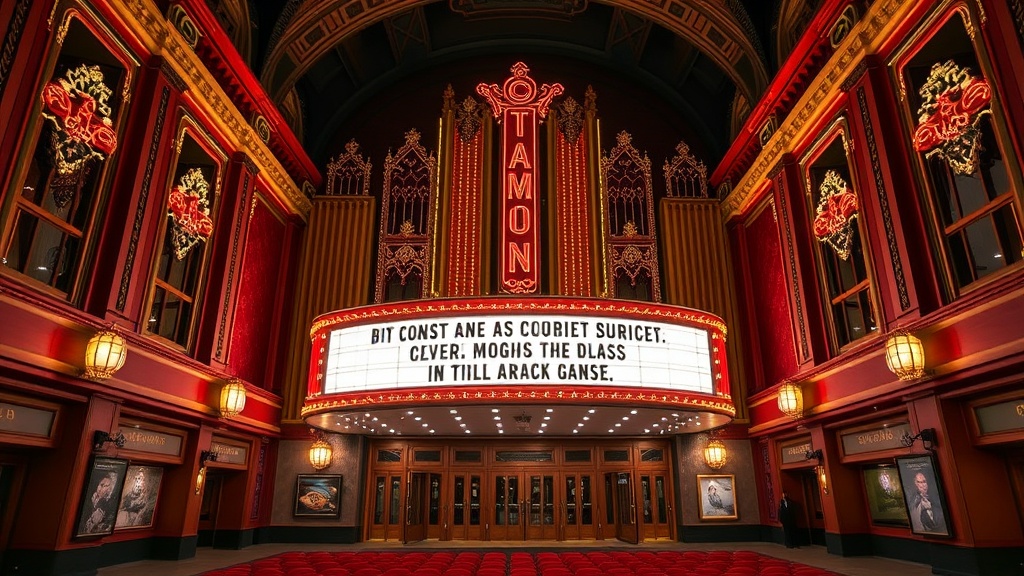
How to Trace Social Shifts Through the Architecture of Historic Movie Palaces

Most people assume the gilded plaster and velvet curtains of a 1920s movie palace were just meant to look expensive. That's a mistake. These buildings weren't just pretty shells for films; they were carefully engineered social tools designed to make every factory worker feel like royalty for the price of a nickel. This post breaks down how you can read the physical layout and design choices of these grand theaters to spot the shifting cultural values of the early 20th century. Understanding these spaces helps us see how entertainment didn't just reflect the American public—it actively worked to reshape their aspirations and behaviors.
Why did early theaters use such over-the-top architectural styles?
The choice of "Exotic" architecture wasn't an accidental whim of a wealthy owner. Architects like Thomas Lamb and John Eberson didn't just want to build a room; they wanted to build a portal. When you walk into a theater designed in the Mayan Revival, Egyptian, or Persian Court style, you're looking at a specific reaction to the crushing industrialization of the era. By the mid-1920s, people worked in grey, monotonous factories and lived in cramped, utilitarian apartments. The movie palace offered a total escape—not just in the story on the screen, but in the physical space itself. By looking at the heavy use of terra cotta and ornate plasterwork (which was almost always painted to mimic expensive marble), you can see how theaters faked luxury to provide a sense of belonging to the masses. It was a form of democratic opulence. If you can identify a specific regional style on the facade, you're often seeing what that specific city's population dreamed of as the "ultimate" elsewhere (like the Oriental Theatre in Chicago or the Fox in Atlanta).
How can you tell an Atmospheric theater from a Standard one?
If you're standing in a theater and the ceiling looks like a deep night sky with twinkling stars and drifting clouds, you're in an "Atmospheric" house. John Eberson pioneered this style to make audiences feel like they were sitting in an outdoor Mediterranean courtyard or a Spanish garden. Standard theaters, like those designed by the Rapp and Rapp firm, were more about "French Renaissance" or "Baroque" grandeur—think massive crystal chandeliers, symmetrical gold leaf, and heavy velvet drapery. You can distinguish them by their verticality. Standard theaters feel enclosed, heavy, and regal; Atmospherics feel expansive, whimsical, and strangely modern for their time. This distinction tells us a lot about the theater owner's strategy: were they trying to impress the audience with traditional European wealth, or were they trying to transport them to a fantasy world where the walls didn't exist? You can find records of these specific designs through the League of Historic American Theatres, which documents the preservation of these distinct styles.
To truly analyze these spaces, you have to look up. In an Atmospheric theater, the "stars" were created by a specific projector called a Brenograph. These machines sat in the projection booth and cast clouds and stars across a curved, rough-plaster ceiling. If you see these projectors still in place, you're looking at the ancestors of modern theme park design. The goal was to eliminate the "boxy" feeling of a room. This shift toward the Atmospheric style in the late 1920s mirrored a broader cultural move toward surrealism and escapism as the economic boom began to show its first cracks.
What do the floor plans reveal about 1920s social classes?
Check the mezzanine and the upper galleries. In older European opera houses, the upper tiers were often separated by physical barriers or entirely different entrances to keep the classes from mixing. In the great American movie palaces, those barriers started to vanish—mostly. While there were still "better" seats, the grand lobby was a shared stage where the shop clerk and the banker stood on the same thick carpet. However, you can still find a darker history in the "segregated" entrances often found in Southern theaters of the time—hidden side doors that led to separate balconies. Reading these floor plans is a direct way to see how Jim Crow laws and class aspirations collided in the same building. You can see detailed architectural drawings of these layouts at Cinema Treasures, a massive database for theater historians.
Beyond the seating, look for the mirrors. Huge, floor-to-ceiling mirrors were often placed in the grand lobbies so patrons could watch themselves—and others—entering the space. It was a site for social performance (think of it as the 1925 version of a red carpet). If you see these massive mirrors, you're looking at a theater designed to facilitate social climbing. People would dress up in their best clothes just to stand in that lobby. The architecture encouraged them to see themselves as part of the "elite" world they saw on the screen. It was a brilliant marketing trick to keep people coming back every week.
You can also spot if a theater was built for silent film only or for "talkies" by looking at the stage depth. A shallow stage—less than 20 feet—usually meant the building was a pure cinema house from the start. A deep stage with a high "fly gallery" (the space above the stage where scenery is pulled up) tells you it was meant for vaudeville and live performance. This physical footprint shows the slow death of vaudeville as cinema became the dominant cultural force. It's a record of the exact moment the screen replaced the live actor in the American heart. When sound came in 1927, many of these grand halls had to be retrofitted with acoustic tiles that often clashed with the original plasterwork. Finding those awkward patches is like finding a scar from a major cultural surgery.
Look closely at the "marble" pillars in many of these lobbies. Often, they're actually scagliola—a plaster technique that creates a convincing faux-marble finish. It's a perfect metaphor for the film industry itself: a convincing illusion created for a fraction of the cost. The use of these materials proves that theater owners were masters of perception. They prioritized the feeling of wealth over the actual substance of it, which aligned perfectly with the aspirational culture of the Roaring Twenties. If the pillars were real marble, the tickets would have been too expensive for the working class. The fake marble was what allowed the democratization of luxury to actually work.
Lastly, don't ignore the air conditioning vents. Many movie palaces were the first buildings in their cities to offer "refrigerated air." If you see massive, ornate vent grilles integrated into the ceiling or wall design, you're seeing the dawn of the modern summer blockbuster. Before this, theaters often closed in the summer because they were too hot. The integration of massive cooling systems into the architecture allowed cinema to become a year-round habit. The size and placement of those vents tell us about the massive technological leap that made the theater a sanctuary from the heat, changing the way Americans spent their leisure time forever.