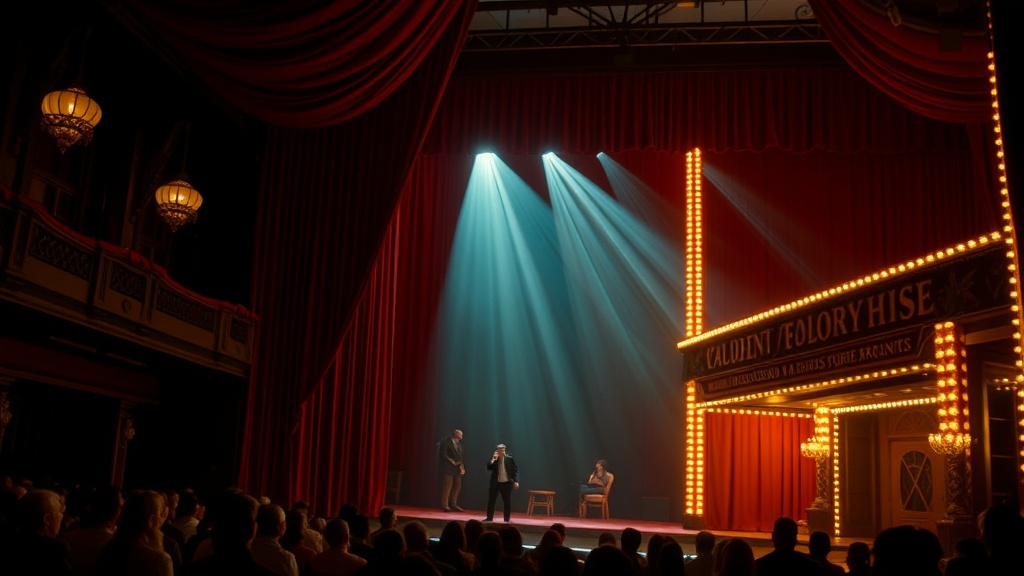
The Strange Evolution of the Vaudeville Stage

Why did Vaudeville become the dominant form of entertainment?
Have you ever wondered why modern variety shows or even certain TikTok trends feel so strangely familiar? The answer often lies in the structure of Vaudeville—a fast-paced, high-energy form of entertainment that defined American culture for decades. It wasn't just a single show; it was a chaotic, brilliant collision of magic, comedy, animal acts, and musical numbers. This wasn't a long, sweeping drama where you sat in silence; it was a rapid-fire bombardment of talent designed to keep a working-class audience on the edge of their seats.
Vaudeville functioned as the backbone of the American entertainment industry before the widespread adoption of film and radio. It offered something for everyone. If you wanted to see a man escape from a water tank, a troupe of acrobats, or a comedian telling jokes about local politics, you didn't go to a specialized theater—you went to a Vaudeville house. This variety-driven model ensured that even if one act failed to land, the next one would likely grab the audience's attention. It was a system of constant movement and immediate gratification.
What made the Vaudeville circuit so successful?
The success of the circuit relied on a rigorous, almost industrial approach to talent. Performers traveled between cities, often following a strictly timed schedule that left little room for error. This was a business of precision. The performers weren't just artists; they were highly disciplined professionals who had to deliver a high-impact act in ten, fifteen, or perhaps twenty minutes. The stakes were high—if your act didn't work, you didn't just lose the crowd; you lost your place on the circuit.
One of the most fascinating aspects was the way these shows acted as a melting pot. As people migrated from rural areas to growing urban centers, Vaudeville provided a shared language of humor and spectacle. It brought together various immigrant groups and different social classes under one roof. While the content was often broad and sometimes stereotypical, it created a common cultural touchstone across the United States. You can see the echoes of this in the way early 20th-century social dynamics played out through performance and satire.
To understand the sheer scale of this era, one might look at the archives of the Library of Congress, which holds many records regarding the social history of American performance. The sheer volume of performers—from the legendary Harry Houdini to countless unnamed jugglers and singers—shows that this was a massive, functioning economy. It wasn't just art; it was a massive engine of employment and movement.
How did the rise of cinema change the stage?
The decline of Vaudeville wasn't a slow fade; it was a collision with a new technology that could do everything a live performer could do, but better and cheaper. The advent of the motion picture changed the rules of the game entirely. Why pay a troupe of acrobats to travel across the country when you can screen a film of them once and show it to a thousand cities simultaneously? The efficiency of film was the death knell for the live variety circuit.
As movies became more sophisticated, the "variety" aspect of the theater became less about live talent and more about the spectacle of the screen. This shift forced many Vaudeville performers to adapt or disappear. Some transitioned into the silent film era, bringing their physical comedy and exaggerated gestures to the silver screen. This transition is a key chapter in entertainment history, as the physical language of Vaudeville became the visual language of early cinema.
A great resource for studying the impact of early film and the shifts in media consumption is the Britannica Encyclopedia, which details the transition from stage to screen. This period of change was jarring for many, but it also birthed the modern concept of the "movie star." The star power that once belonged to the stage magician or the singing comedian was transferred to the actor on the screen, forever changing how the public interacted with their idols.
What legacy did these variety acts leave behind?
Even though the physical Vaudeville theaters are mostly gone—replaced by modern cinemas or repurposed as other types of buildings—their DNA is everywhere. You see it in the structure of late-night talk shows, where a host interacts with a musical guest and a comedian in a way that mimics a Vaudeville lineup. You see it in the short-form content of the digital age, where the ability to capture attention in a few seconds is the difference between success and obscurity.
The structure of the "act"—the idea of a singular, high-impact performance—remains the fundamental unit of entertainment. Vaudeville taught the industry that audiences have short attention spans and a hunger for novelty. It was a school for the modern entertainer, teaching them how to command a room (or a screen) through sheer presence and timing. The ghosts of the Vaudeville stage still haunt the way we consume media today, whether we are watching a professional athlete's highlight reel or a comedian's stand-up special.
Looking back, the era was a wild, unrefined period of experimentation. It was a time when a single stage could host a world-class illusionist one moment and a local singing sensation the next. It was unpredictable, often messy, and deeply human. It set the stage for the professionalized, high-production-value entertainment that we take for granted today, proving that the desire for variety is a constant in human culture.