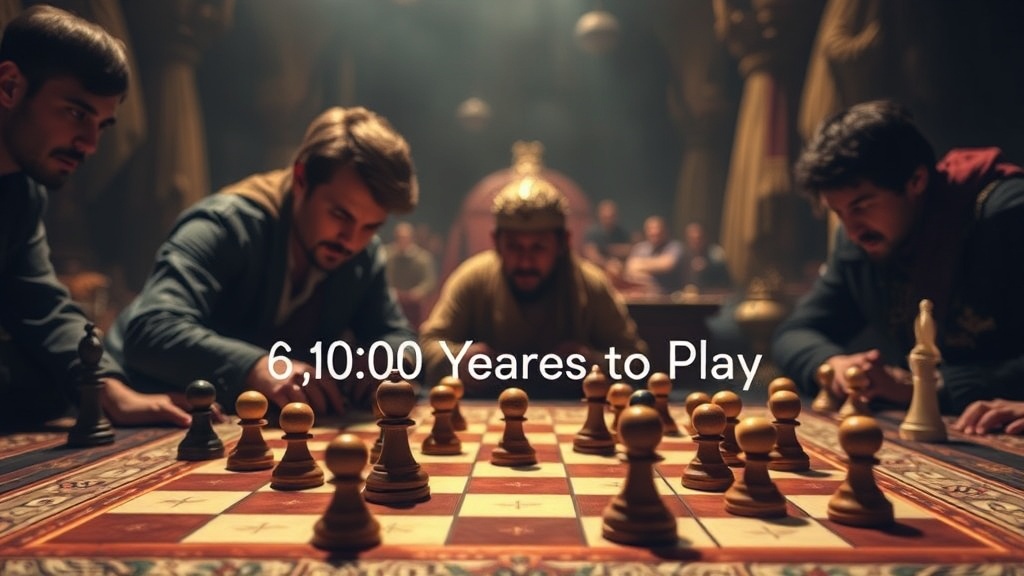
The Surprising Ancient Origins of Board Games: 5,000 Years of Play

Board games didn't start in some suburban basement in 1975. This post traces the roots of tabletop gaming across five millennia — from Egyptian royal tombs to Viking shipwrecks — and explains why understanding this history changes how you view game night. Whether you're a casual Catan player or someone with a dedicated shelf for your Ticket to Ride collection, the story behind these games is stranger and more fascinating than most rulebooks suggest.
What's the oldest board game ever discovered?
Senet takes the crown. Archaeologists unearthed this game in the tombs of Egyptian pharaohs dating back to 3500 BCE — that's over 5,500 years ago. The game featured a distinctive grid of thirty squares arranged in three rows of ten. Players moved pieces according to casting sticks (the ancient equivalent of dice) and aimed to reach the final squares, which represented the afterlife.
Here's the thing — Senet wasn't just entertainment. Tomb paintings at sites like the British Museum's Egyptian collection depict the deceased playing against invisible opponents. The game became a metaphor for the soul's path through the underworld, with each square carrying religious significance. Boards have been found crafted from wood, faience, and even solid gold in the tomb of Tutankhamun.
The rules? Lost to time — mostly. Historians have reconstructed plausible gameplay based on later Egyptian texts, but the spiritual dimensions remain partially mysterious. What we do know is that Senet remained popular for nearly three thousand years. That's longer than chess has existed.
How did ancient civilizations use board games?
Beyond entertainment, board games served as training tools, diplomatic gifts, and religious instruments across multiple cultures. The Romans used ludus latrunculorum — a military strategy game resembling chess — to teach tactical thinking to soldiers. Boards carved into stone appear at military outposts along Hadrian's Wall, suggesting bored legionnaires passed countless evenings hunched over captured pieces.
In ancient India, the game of Chaturanga (the direct ancestor of chess) emerged around 600 CE. Unlike modern chess, this four-player variant used dice to determine moves and incorporated elements of the Indian military: elephants, chariots, cavalry, and foot soldiers. The game spread along trade routes, morphing into Shatranj in Persia and eventually the two-player chess recognized worldwide today.
The catch? Games often carried political weight. Chinese Go — developed roughly 4,000 years ago — became a test of character among scholars and officials. Confucius himself reportedly praised the game for developing patience and foresight. By the Tang dynasty, Go mastery could influence one's career prospects in the imperial bureaucracy. That's a far cry from modern "gaming credentials" on a resume.
What board games did Vikings and medieval Europeans play?
The Hnefatafl family dominated Nordic gaming for centuries. Unlike the symmetrical battle of chess, Hnefatafl pitted a king and his defenders against twice as many attackers. The king's goal: escape to the board's edge. The attackers' goal: surround and capture him. Archaeologists have discovered over 400 Hnefatafl boards — many carved into portable wooden pieces that Vikings carried on longships.
The National Museum of Ireland holds a particularly fine example: a gaming board from the 10th century that flips to reveal a Hnefatafl grid on one side and a nine men's morris pattern on the other. Dual-purpose gaming — space-efficient and practical for cramped ship quarters.
Worth noting: Hnefetafl faded into obscurity as chess spread northward during the 11th and 12th centuries. The older game simply couldn't compete with chess's standardized rules and royal endorsements. (Charlemagne allegedly gifted chess sets to visiting dignitaries — early influencer marketing.) By 1600, Hnefatafl had nearly vanished from living memory, surviving only in remote Scandinavian fishing villages.
How do ancient games compare to modern ones?
The similarities are striking. Ancient players complained about luck, boasted about victories, and apparently cheated just as frequently as modern enthusiasts. A 3,000-year-old Egyptian papyrus includes a poem where a player trash-talks his opponent after a Senet win — plus ça change.
That said, the differences matter too. Ancient games rarely had written rules. Players learned through oral tradition, which meant regional variations flourished. A Roman playing latrunculi in Britain likely followed slightly different conventions than one in Rome. Standardization arrived only with mass printing in the 15th century.
Consider the materials. Modern games use cardboard, plastic, and smartphone apps. Ancient gamers worked with:
- Stone: Permanent but immovable — think tavern tables with carved boards
- Wood: Lightweight and carveable, though prone to rot (explaining why few survive)
- Precious metals: Status symbols for elites — gold and silver pieces appear in multiple royal burials
- Clay and ceramic: Cheap, durable, and moldable into dice and tokens
| Game | Origin | Approximate Age | Modern Descendant |
|---|---|---|---|
| Senet | Egypt | 3500 BCE | None (extinct) |
| Go | China | 2000 BCE | Go (unchanged) |
| Royal Game of Ur | Mesopotamia | 2600 BCE | Backgammon |
| Chaturanga | India | 600 CE | Chess |
| Hnefatafl | Scandinavia | 400 CE | None (extinct) |
| Nine Men's Morris | Uncertain | 1400 BCE | Various mill games |
Why did some ancient games survive while others disappeared?
Survival wasn't about quality — it was about institutional backing. Chess thrived because Islamic and European courts patronized it. Go persisted through Chinese imperial examination culture, where skill signaled intellectual refinement. Games without powerful sponsors — like Hnefatafl or the Mesopotamian Royal Game of Ur — faded despite being perfectly enjoyable.
The Royal Game of Ur presents a fascinating case study. Archaeologist Sir Leonard Woolley discovered a beautifully preserved board in the royal cemetery at Ur (modern Iraq) in the 1920s — buried roughly 4,500 years ago. For decades, the rules remained unknown. Then a Babylonian tablet — housed at the British Museum — revealed the gameplay in 1990. Irving Finkel, the museum's cuneiform expert, deciphered the rules and demonstrated them publicly. Within years, the game experienced a minor revival.
Contrast this with pachisi, the Indian cross-and-circle game that evolved into the Western Parcheesi and Sorry! Commercial publishers — specifically Selchow & Righter — trademarked and mass-produced versions in the late 19th century. Copyright protection and marketing budgets accomplished what pharaohs' tombs could not: permanent cultural embedding.
The psychology hasn't changed much
Neuroscientists studying ancient game boards have noted something curious. The cognitive demands of Senet — probabilistic thinking, spatial reasoning, opponent modeling — activate brain regions nearly identical to those engaged by modern strategy games. Humans haven't evolved new mental hardware for board gaming in five millennia. We've just refined the software.
Parents in ancient Thebes probably nagged children about playing too much Senet. Roman soldiers definitely gambled over latrunculi matches — gambling dice turn up constantly at archaeological sites. Medieval monks were explicitly forbidden from playing chess in multiple monastic rules, suggesting the temptation was widespread. The context shifts. The behavior doesn't.
What can modern game designers learn from ancient examples?
Simplicity scales. The most enduring ancient games — Go, chess, backgammon — share elegant rules that generate complex emergent behavior. Senet had relatively simple movement rules but layered religious significance atop mechanical simplicity. Modern hits like Splendor or 7 Wonders follow similar principles: learn in ten minutes, master over years.
Physical objects carry meaning. A weighted chess piece feels different from a plastic pawn. The British Museum sells replicas of the Royal Game of Ur board — and players consistently report that the wooden construction and inlaid decorations enhance the experience beyond mere gameplay. Tactile quality signals intentionality.
Here's the thing about rulebooks — ancient games rarely had them. This created flexibility but also barriers to entry. Modern designers have the opposite problem:过度-specified rules that stifle house variants. The sweet spot might lie somewhere between Roman oral tradition and modern 40-page instruction manuals. Codenames — a modern party game — succeeds partly because its rulebook fits on a single card. Ancient wisdom rediscovered.
Next time you open a new game from Asmodee or Stonemaier Games, remember: you're participating in a tradition older than written history. The cardboard might be new. The impulse — to gather, to compete, to tell stories through play — that's 5,000 years strong and counting.