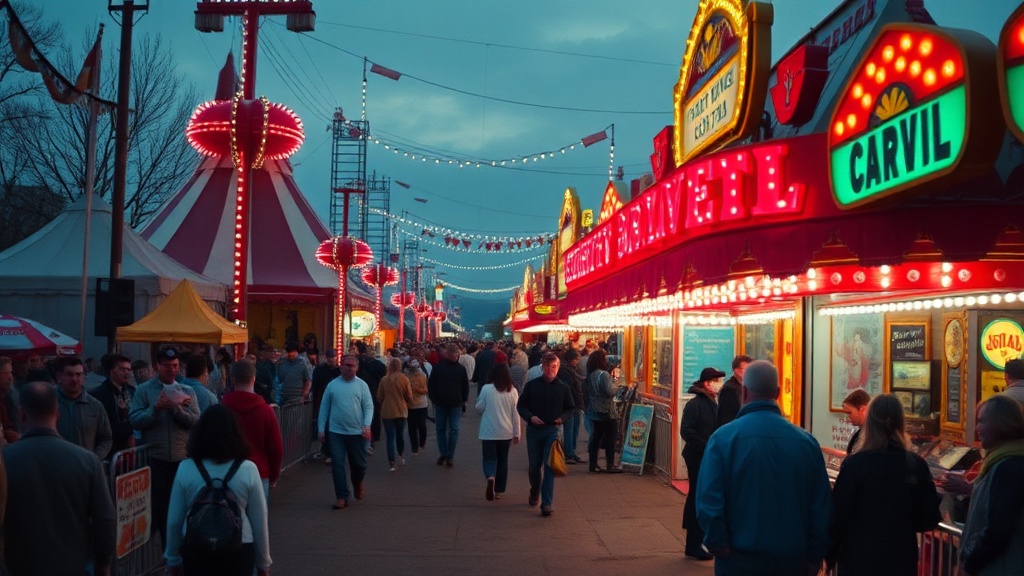
Why Carnival Midways Still Reflect Our Deepest Cultural Anxieties

What Can a Rickety Roller Coaster Tell Us About Who We Were?
Ever stood in line for a carnival ride and wondered why you're willingly paying to be terrified? There's something peculiar about amusement culture—we hand over cash to confront manufactured dangers, gawk at curated oddities, and test our skills at rigged games we'll probably lose. But here's what most visitors miss: every carnival midway is a time capsule. Those flashing lights and calliope tunes encode decades of shifting social values, economic anxieties, and cultural fascinations that would take volumes to explain otherwise. The history of entertainment isn't just about what made people laugh—it's about what made them nervous, what they considered "other," and how they defined "normal" in any given era.
From the traveling shows of the 1880s to today's immersive horror attractions, carnival entertainment has always held up a distorted mirror to society. The rides we build, the exhibits we pay to see, and even the food we associate with fairgrounds reveal patterns about collective fear, technological optimism, and changing attitudes toward the human body. Let's walk through this historical funhouse together—and see what reflections stare back.
When Did We Stop Paying to See "Human Oddities"?
The sideshow tent was once the crown jewel of any self-respecting carnival. Through the late 19th and early 20th centuries, audiences queued for hours to glimpse conjoined twins, bearded ladies, "savages" from distant lands, and performers with various physical differences. These exhibits weren't framed as medical curiosities—they were marketed as entertainment, with lurid paintings promising glimpses of nature's mistakes and foreign freaks.
What changed? The short answer: everything. Medical advances demystified many conditions that once seemed supernatural. Disability rights movements gained visibility and political power. Television brought global cultures into living rooms, making the "exotic foreigner" pitch ring increasingly hollow and offensive. By the 1970s, most major carnivals had shuttered their human sideshows—not from sudden enlightenment, but because audiences stopped buying tickets. The profit motive, ironically, dragged carnival culture toward something resembling ethical progress.
But here's the fascinating part: we didn't stop wanting to see difference. We just redirected that gaze. Modern horror mazes and extreme attractions now offer "safe" encounters with deformity, disease, and death. Zombie walks, medical oddity museums, and true crime exhibitions satisfy the same curiosity that once sent Victorians to gawk at living performers—just with better lighting and consent forms. The midway's function as a space for confronting bodily difference never disappeared; it simply went underground, then resurfaced wearing different costumes.
Why Did We Build "Funhouses" Right When Psychology Was Getting Weird?
The 1920s and 1930s saw an explosion of funhouse construction across American amusement parks and traveling carnivals. These weren't merely collections of mirrors and moving floors—they were architectural experiments in disorientation. Rotating barrels, tilting rooms, and sudden drops created spaces where the reliable physics of everyday life temporarily suspended.
This timing wasn't coincidental. The funhouse emerged alongside Freud's popularization in America, surrealism's rise in European art, and growing public fascination with the unconscious mind. Psychologists were busily demonstrating that perception was unreliable, that the mind constructed reality rather than simply recording it. Carnival entrepreneurs—always quick to monetize cultural trends—built physical spaces where visitors could experience these theories viscerally.
The classic funhouse also reflected broader anxieties about urbanization and mechanization. City dwellers were navigating increasingly complex built environments: subways, skyscrapers, elevators, and electric signs created sensory overload that rural life hadn't prepared them for. The funhouse distilled this chaos into a contained experience—frightening but temporary, disorienting but ultimately safe. It offered practice in managing the vertigo of modern life.
Contemporary "escape rooms" and immersive theater productions continue this tradition, though they've swapped mechanical tricks for narrative complexity. We're still paying to have our perceptions manipulated, still seeking spaces where reality's rules bend. The technology has improved, but the psychological contract remains unchanged: temporary surrender of control in exchange for structured thrill.
How Did Carnival Games Become Commentary on Class and Luck?
Walk any midway today and you'll find the same familiar challenges: knock down weighted bottles, toss rings onto bottles, shoot targets with questionable aim. These games seem timeless, even universal. But their specific designs encode fascinating assumptions about skill, chance, and economic mobility.
Early carnival games (circa 1890-1920) heavily emphasized pure chance. Wheels of fortune, lottery-style drawings, and guessing games dominated because they required no skill—just money and optimism. This reflected a Gilded Age economy where industrial consolidation made individual effort feel increasingly disconnected from outcomes. The game operator wasn't cheating exactly; the entire setup advertised its own randomness. Players weren't buying a fair contest—they were purchasing hope.
The shift toward skill-based games accelerated during the 1950s and 1960s, coinciding with postwar meritocracy narratives. Games featuring ring tosses, basketball shots, and shooting galleries suggested that effort and talent could reliably produce rewards. The messaging was subtle but clear: practice makes perfect, persistence pays off, you too could win the giant stuffed animal if you just tried hard enough. Of course, the games remained rigged—softballs were underinflated, baskets were oval rather than round—but the illusion of meritocratic fairness mattered more than actual fairness.
Today's carnival games increasingly incorporate both elements simultaneously. Games that seem skill-based secretly rely on chance; games advertising luck actually reward practiced technique. This ambiguity perhaps mirrors our own uncertain economic landscape, where credentials no longer guarantee employment, entrepreneurship feels like gambling, and the relationship between effort and outcome has grown murky once again. The midway game remains a microcosm of how we believe—or want to believe—success operates in the wider world.
What Do Our Thrill Rides Reveal About Technological Optimism?
The evolution of carnival rides offers a remarkably precise index of society's relationship with machinery and speed. Early 20th-century attractions—the roller coasters of Coney Island, the rotating barrels, the centrifugal spinners—celebrated industrial power. They translated factory mechanisms into pleasure devices, suggesting that the same forces transforming work and travel could also generate delight. Riding these contraptions meant participating in modernity itself.
Post-World War II rides grew gentler, more family-oriented. The baby boom demanded attractions suitable for children, certainly, but this shift also reflected nuclear-age anxieties. After Hiroshima and during the Cold War, unbridled technological enthusiasm felt naive. Rides became safer, more controlled, often themed around fantasy narratives rather than mechanical prowess. The Disneyland model—story-driven, carefully managed, obsessively safe—increasingly dominated carnival design.
The 1990s and 2000s saw a pendulum swing toward "extreme" attractions: taller drops, faster accelerations, more aggressive inversions. This revival of mechanical intensity coincided with digital culture's rise. As everyday life grew increasingly virtual and sedentary, physical rides offered something screens couldn't—genuine bodily risk, actual gravity, real acceleration forces. The return of aggressive thrill rides perhaps represented nostalgia for embodied experience in an increasingly disembodied age.
Current trends suggest another shift: immersive, narrative-driven attractions that blend physical movement with virtual reality and elaborate theming. These hybrid experiences acknowledge that pure mechanical thrill may have reached its limits—we can only drop so fast, spin so hard—while recognizing that contemporary audiences crave storytelling integration. The ride vehicle becomes a vehicle for narrative transportation, not merely physical.
Why Did We Start Eating Deep-Fried Everything at the Fair?
Carnival food has always been indulgent—cotton candy was literally invented by a dentist for the 1904 World's Fair—but the recent explosion of extreme fair foods (deep-fried butter, bacon-wrapped everything, food-on-a-stick innovations) deserves historical attention. These culinary stunts emerged during the 2000s, a period of economic uncertainty and dietary polarization.
The trend makes cultural sense when contextualized. As middle-class wages stagnated and wealth inequality grew visible, carnival food offered democratic luxury—a few dollars purchased transgressive indulgence that would cost hundreds at a fine restaurant. Simultaneously, as public health messaging about obesity became unavoidable, extreme fair foods became vehicles for rebellion against nutritional correctness. Eating deep-fried Coca-Cola or a bacon-wrapped turkey leg represented temporary rejection of middle-class bodily discipline.
The Instagram era amplified this tendency. Carnival foods became designed for photography as much as consumption—visual spectacle became part of the digestive process. This digital documentation transformed eating from private pleasure to public performance, with the midway providing appropriately theatrical backdrops for culinary exhibitionism.
There's continuity here with older carnival traditions. The freak show didn't disappear—it migrated onto our plates. We now consume the "freaky" and "extreme" rather than gazing at human difference. The midway's function as a space for sanctioned transgression persists, just redirected toward cholesterol rather than physiology.
"The carnival is the sanctioned release of the repressed—a space where normal rules suspend temporarily, revealing what we actually value by showing us what we're willing to pay to transgress." — Cultural historian John Kasson, Amusing the Million
What Will Tomorrow's Midways Tell Our Grandchildren About Us?
Carnival entertainment will undoubtedly survive in some form—humans have always sought spaces for structured risk and collective spectacle. But the specific attractions we build, the games we design, and the foods we sell will encode messages about our anxieties, our technological capabilities, and our ethical boundaries. Future historians won't need archaeology to understand our values; they'll examine ride patents and midway game mechanics.
The midway has always been more honest than museums or textbooks about what societies actually believe. It shows us our prejudices before we manage to conceal them, our fears before we develop language to articulate them, our pleasures before we rationalize them as respectable. Next time you find yourself clutching a cardboard tray of fried dough while watching teenagers scream on a spinning contraption, remember—you're participating in a tradition of cultural revelation that stretches back over a century. The carnival doesn't lie about who we are. It just charges admission to show us the truth.
For deeper exploration of amusement culture's historical development, the National Fairground and Circus Archive at the University of Sheffield maintains extensive collections documenting traveling show culture from the Victorian era forward.